
- James 3:1 Let not many of you become teachers, my brethren, knowing that as such we will incur a stricter judgment.
- Hebrews 13:7 Remember those who led you, who spoke the word of God to you; and considering the result of their conduct, imitate their faith ( Heb 6:12, 1 Corinthians 4:17, 11:1, Philippians 3:17, 2 Thessalonians 3:7,9 etc.).
I recently came across another example from a leader who I once met from another country getting caught in some serious sins, but taking an approach to avoid clearity in a repentance process. It was very grevious to me but typical in what we are seeing today across the body of Christ. In my five decades of serving Jesus, much of it in leadership, I have never seen so many leadership failures exposed AND so much uncertainty about whether genuine repentance has occurred.
Sin among leaders is nothing new. Scripture records serious failures among leaders, yet it also shows the importance of bringing sin into the light and responding to it Biblically. You see it in the Biblical heroes of faith in Hebrews 11. Eleven of the seventeen people mentioned lapsed into immorality and sin (some incredibly perverse) at some point in their lives. The difference between these examples and what we see today is that the sins in the Hebrews 11 leaders were clearly brought to light and repented of. Today, the story is very different!
The question is not whether sin will occur among God’s people, but how we will respond when it does. Today, unclear responses to leadership scandals have created a destructive fog that damages God’s people and weakens our witness to the world.
This fog makes it difficult to distinguish genuine repentance from unclear expressions of semi-remorse intended to protect a leader’s reputation, position, or influence.
Ambiguous Repentance and the Corresponding Spiritual Confusion Among God’s People
There is a significant difference between saying, “I may not have done everything right,” and declaring, “I sinned in this specific way, accept responsibility, and am willing to submit to a Biblical process of repentance.”
When repentance is ambiguous, accountability becomes negotiable. Leaders may retain influence without adequately addressing their wrongdoing or its consequences. The result is wounded people, spiritual confusion, and a weakened testimony of the transforming power of the gospel.
James 3:1 reminds us that those entrusted with spiritual influence face stricter judgment. Leadership should increase our willingness to embrace accountability, not provide opportunities to evade it.
What does Biblical repentance in leaders look like?
John the Baptist declared, “Bear fruit in keeping with repentance” (Matthew 3:8). Genuine repentance is demonstrated through observable change, not merely evasive or sorrowful words.
Paul provides a compelling example in his letters to the Corinthians. In 1 Corinthians 5, he confronted a serious sexual sin that the church had failed to address. We know there was a prominent member of the church (most historical commentators believe he was a man of high influence/leadership well known among the whole church) involved in an ongoing sexual relationship with his stepmother, and it was not being dealt with.
Paul emphasized that allowing the sin to continue was worse than the sins of unbelievers and how they would handle it (1 Corinthians 5:1), which was a serious rebuke! Paul commanded them to deal with the man’s sin head-on (1 Corinthians 5:2-7) and banish him from the church. Paul himself said, “I have already judged him and turned him over to Satan for the destruction of his flesh.” This is the most severe approach to someone in sin that we saw from the apostle Paul. There were no nebulous or ambiguous approaches here.
By the time of 2 Corinthians 2:5-11, the situation had changed sufficiently for Paul to urge the church to “forgive and comfort the repentant individual and reaffirm their love for him.”
Paul further describes the fruit of genuine repentance in 2 Corinthians 7:9–11:
- “For behold what earnestness this very thing, this godly sorrow, has produced in you: what vindication of yourselves, what indignation, what fear, what longing, what zeal, what avenging of wrong! In everything you demonstrated yourselves to be innocent in the matter.”
These qualities provide a biblical standard for evaluating repentance today.
The Clear Fruit of Repentance
Paul identifies several responses that should accompany genuine repentance:
- Earnestness: Diligently addressing the wrongdoing rather than minimizing or ignoring it.
- Vindication: Taking responsibility and making things right, not defending one’s reputation at the expense of truth.
- Indignation: Recognizing the seriousness of the sin and its damaging effects.
- Fear: Developing a renewed reverence for God and concern about the consequences of tolerating sin.
- Longing: Desiring to see the wrongdoing and its effects properly addressed.
- Zeal: Acting with determination to restore what has been damaged and uphold God’s honor.
- Avenging of wrong: Taking appropriate action to address the wrongdoing and its consequences rather than concealing them.
- Demonstrated innocence: Providing evidence that the matter has been thoroughly addressed and that the church has responded faithfully.
One particularly important point is that wrongdoing cannot be adequately addressed if it remains ambiguous or unidentified. There can be no meaningful correction of a wrong that no one is willing to acknowledge.
An Essential Posture of Leaders Who Sin Which Eliminates the Destructive Fog of Ambiguous Repentance.
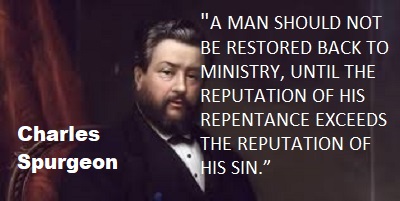
Charles Spurgeon quotes from John James and gives us a clear example of the fruit of repentance among leaders corresponding to 2 Corinthians 7.
- Spurgeon echoed this in his “Lectures to My Students,” “ But I question, gravely question whether a man who has grossly sinned should be very readily restored to the pulpit. As John Angell James (1785-1859) remarks, “When a preacher of righteousness has stood in the way of sinners, he should never again open his lips in the great congregation until his repentance is as notorious as his sin.”
To move from ambiguous remorse to Biblical repentance, leaders and those providing oversight should:
- Clearly confess the sin without minimizing it, shifting blame, or hiding behind vague statements (Proverbs 28:13).
- Demonstrate changed behavior that provides observable evidence of repentance (Matthew 3:8).
- Submit to genuine accountability from trustworthy, appropriately qualified leaders who are not controlled by the individual under review.
- Address the harm done by taking responsibility, correcting misinformation, and making restitution where appropriate.
- Allow restoration to follow Biblical standards. Forgiveness does not automatically qualify someone to return to leadership. Trust and leadership qualifications must be evaluated carefully over time.
God’s goal is neither to abandon fallen leaders nor to restore them prematurely in the name of grace. It is to follow God’s Biblical pattern: bring sin into the light, require the fruit of repentance, address the damage, and pursue appropriate restoration.
May we see more and more examples in which the testimony of genuine repentance becomes as evident as the testimony of the sin itself. Only then can the destructive fog of ambiguous repentance begin to lift, allowing God’s people to walk in truth, accountability, and the transforming power of the gospel.